Home › Zodiac & Astrology › Synastry in Astrology: Reading Two Charts Together
Synastry in Astrology: Reading Two Charts Together
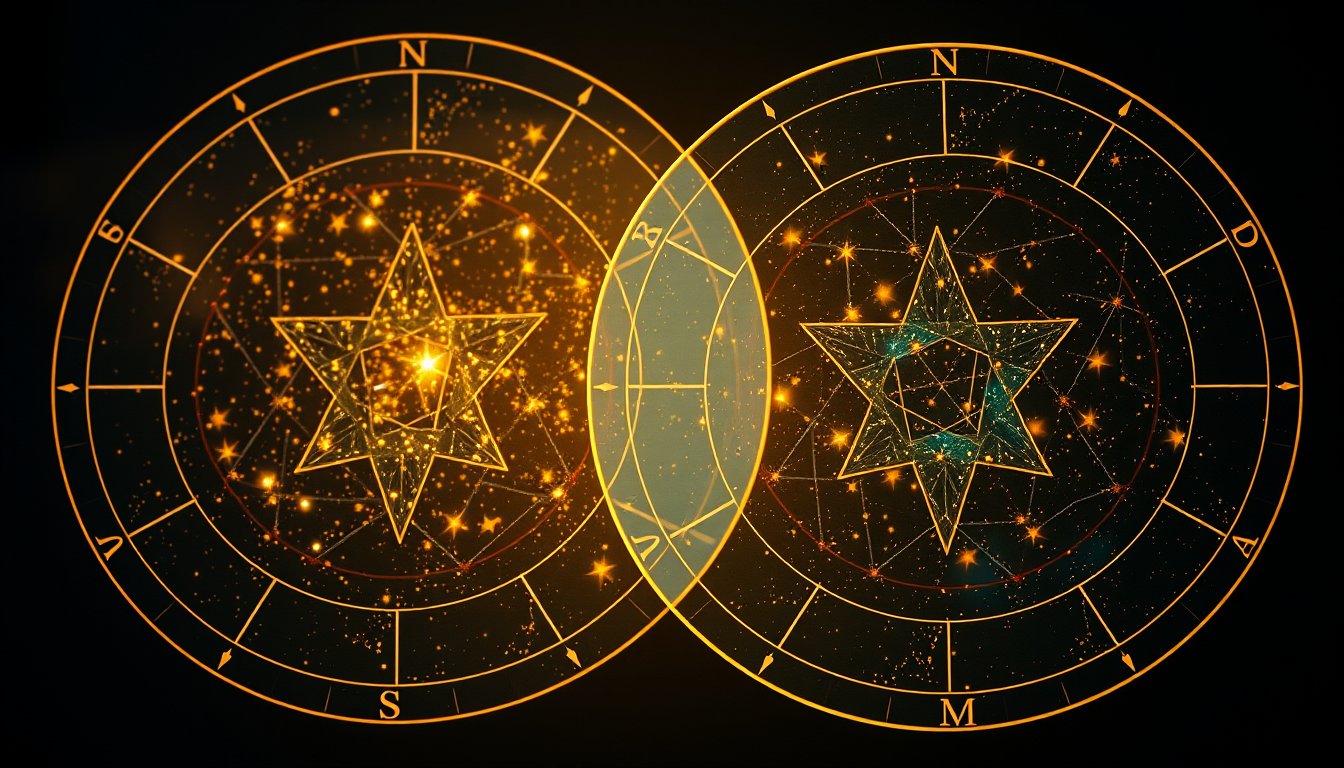
Synastry is the branch of astrology that compares two birth charts rather than reading one alone. It asks how each person's planets land on the other's, which areas of life light up when the two are together, and where the friction sits. The method is the same chart work as a single reading, laid over a second chart.
What Synastry Compares
The method places two wheels side by side, or one inside the other, then reads the contacts between them. Both charts must be accurate, since a wrong birth time moves the Ascendant and the houses and therefore changes which areas of life are activated.
Astrologers usually start with the Sun, Moon, Venus and Mars of each person, because those four carry the most weight in relationships, then move outward to the personal and outer planets. Saturn and the outer planets describe the structure and duration of a bond rather than its daily mood.
It also helps to know which chart is doing which job. Practice usually keeps one person's planets as the moving points and the other's chart as the field those points fall into, and states plainly which way round the comparison is being read, because the two directions give different pictures.
Overlays: Where Planets Fall in the Other Chart
An overlay takes one person's planets and drops them into the other person's houses. If your Venus lands in my seventh house, my sense of partnership is stirred by you. If your Saturn lands in my fourth, home life with you takes on duty or restraint.
Overlays describe what the relationship draws out of each person. They are not one way in effect: a planet in someone's house changes how that house feels, and both people tend to notice the change.
Cross Aspects Between the Charts
Cross aspects are the angles between one person's planets and the other's. Tight contacts are read first.
- Sun to Moon — Recognition and ease, often felt quickly.
- Venus to Mars — Attraction, with the charge running both ways.
- Moon to Moon — Shared emotional need, or mismatched habits of comfort.
- Sun to Saturn — Respect and duty, sometimes weight.
- Venus to Saturn — Loyalty and endurance, sometimes delay or caution.
- Moon to Saturn — Security and seriousness, occasionally coldness.
- Mars to Mars — Drive and competition, energising or abrasive.
- Jupiter to Sun or Moon — Encouragement, generosity, a sense of expansion.
Composite Charts
A composite chart takes the midpoint between two people's planets and builds a single chart from them. The result describes the relationship as its own entity rather than two separate people, which is useful for reading patterns neither person owns alone.
There is also the Davison chart, which computes a midpoint in time and space and casts a conventional chart for that moment. Both techniques are read like a natal chart, with the same houses, signs and aspects, and both can be compared back against the two individuals.
Reading Synastry Without Overselling
Charts of any two people contain some harmonious contacts and some difficult ones. A reading that only collects the trines is dishonest, and one that only hunts for the squares mistakes difficulty for doom.
The honest use of synastry is to name the dynamics clearly: where understanding comes easily, where patience is required, and which parts of each person the other tends to draw out. What people do with that description sits outside the chart's reach.
Timing sits outside the comparison as well. Two charts that describe an easy bond can meet at a difficult moment, and a tense comparison can settle once both people have moved through a hard transit. Synastry also says nothing about how long two people have known each other, though that history often changes how the same contacts are experienced.